No products in the basket.
Return To Shop




What do coloured traffic cones mean on UK sites? Blue, yellow and green explained
Most people know the orange traffic cone. It is the most deployed piece of temporary traffic management equipment in the UK. Chapter 8 of the Traffic Signs Manual specifies it as the standard colour for highway works, and it sits in every traffic management contractor's fleet by default. But walk onto a utility excavation, a civil engineering project, a warehouse, or a construction site running multiple service types simultaneously, and you will almost certainly see something else: blue cones, yellow cones, green cones. This guide explains what each colour means, where it is used, and why it matters.
Why colour-coded cones exist
The orange cone tells a driver or operative that something is happening ahead. It does not tell them what. On a single-service street works job, that is fine. One team, one service, one hazard. But on a multi-utility corridor where gas, water, electricity, and telecoms are all being worked on within a few metres of each other, an orange cone on its own communicates nothing about which service is being excavated, which trench is live, or which area carries the highest risk.
Colour-coded cones solve this. They extend the language of site safety beyond a generic hazard signal into a specific communication system. When an operative sees a blue cone, they know they are near water infrastructure. A yellow cone means electrical risk. A green cone marks a protected or low-risk zone. No sign required. No briefing needed. The cone does the communicating.
This system is not enshrined in Chapter 8, which is specific to highway traffic management. It is established industry practice, built up over decades of use across UK construction, utilities, water, and civil engineering. It is recognised by principal contractors, utility asset owners, and site safety professionals across the country.
The standard: orange
Before covering coloured variants, it is worth being clear about the baseline. Orange is the statutory Chapter 8 colour for road traffic cones used in temporary traffic management on UK public highways. The Traffic Signs Manual Chapter 8, the Traffic Signs Regulations and General Directions, and BS EN 13422 all reference the orange cone as the standard. If you are running a lane closure on an A-road, managing a street works scheme, or deploying cones on any public highway, orange is what Chapter 8 requires.
Coloured cones are used on construction sites, utility works, industrial facilities, and events where colour coding serves an additional purpose beyond standard highway traffic management. They are not substitutes for orange on public roads.
Blue traffic cones: water, utilities, and civil engineering
Blue — water mains and utility works
Water industryBlue is the recognised convention for water mains, potable water services, and subterranean utility works in the UK. The colour follows the same logic as the colour-coding used on utility maps and service marking paint: blue for water. On a water main excavation, deploying blue cones around the trench tells every person on site what service is exposed.
On a multi-utility corridor where several service types run in parallel, blue cones separate the water infrastructure from the gas, the electric, and the telecoms. The cones create a visible, colour-coded map of the work area at ground level. Water industry contractors, civil engineers, drainage teams, and groundworks companies are the primary buyers. Blue cones are also used to mark water-related infrastructure on operational sites including pumping stations, treatment works, and reservoir maintenance operations.
Where blue cones are used:
- Water main excavations and repairs
- Multi-utility corridor works
- Subterranean service surveys
- Civil engineering drainage and sewerage projects
- Water industry operational site demarcation

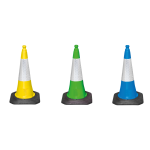
Starlite 750mm Blue Two-Piece Road Traffic Cone
BSI Kitemarked · BS EN 13422 · Starlux prismatic sleeve · SKU: RS2RC750BLU
Shop now — £19.99 exc. VATYellow traffic cones: electrical works and industrial hazard zones
Yellow — electrical hazard zones and industrial sites
Electrical hazardYellow is the established colour for electrical hazard zones, cable risk areas, and H&S warning boundaries on UK construction and industrial sites. It carries immediate hazard recognition. Yellow is already the colour of caution and electrical risk across a wide range of safety systems in the UK, from hazard warning signs to electrical safety labels, and that association transfers directly to cone colour coding.
On a construction site, yellow cones mark the boundary of an electrical works area, a cable corridor, or a high-voltage infrastructure zone. On a multi-utility site, they separate electrical cable works from water, gas, and telecoms operations. On an industrial site or in a warehouse, yellow is the standard colour for machinery exclusion zones, forklift routes, and pedestrian walkway boundaries. Yellow cones can also be paired with specialist overhead cables warning sleeves to add a second layer of hazard communication on sites near live electrical infrastructure.
Where yellow cones are used:
- Overhead and underground cable hazard zones
- High-voltage substation and electrical infrastructure works
- Multi-utility sites distinguishing electrical from other services
- Warehouse and distribution centre aisle demarcation
- Manufacturing and industrial H&S zone boundaries
- Construction site electrical compound perimeters

Starlite 750mm Yellow Two-Piece Road Traffic Cone
BSI Kitemarked · BS EN 13422 · Starlux prismatic sleeve · SKU: RS2RC750YEL
Shop now — £19.99 exc. VATGreen traffic cones: ecological zones, welfare areas, and low-risk boundaries
Green — protected zones and low-risk boundaries
Protected zonesGreen signals something different from blue and yellow. Where blue and yellow communicate specific hazard types, green signals a protected or low-risk zone. It tells operatives they are at a boundary they should respect, not because of an active hazard, but because the area on the other side requires protection.
On construction sites, green cones are most commonly used to mark Tree Preservation Order (TPO) root protection zones, ecological buffer areas, and protected habitat boundaries. Planning permissions on development sites frequently include conditions requiring the physical demarcation of TPO trees and protected ecological areas throughout the construction phase. Green cones are a practical, portable, and recognised way to mark those boundaries without permanent infrastructure.
Green is also used for welfare area boundaries on large construction sites, separating rest areas and welfare facilities from active work zones. On agricultural sites, outdoor events, and environmental monitoring sites, green marks low-risk demarcation and access control perimeters.
Where green cones are used:
- TPO root protection zone boundaries
- Ecological buffer zones and protected habitat perimeters
- Welfare area boundaries on construction sites
- Agricultural and farming operations
- Outdoor events and festival demarcation
- Environmental monitoring and survey sites
- Low-risk site compound zoning

Starlite 750mm Green Two-Piece Road Traffic Cone
BSI Kitemarked · BS EN 13422 · Starlux prismatic sleeve · SKU: RS2RC750GRN
Shop now — £19.99 exc. VATInteractive colour explorer
Select any colour card below to see a summary of its applications and a direct link to the product.
🔵
Blue
Water mains, utilities, civil engineering
Water industry 🟡
Yellow
Electrical works, cable hazard zones, warehouses
Electrical hazard 🟢
Green
Ecological zones, welfare boundaries, TPO areas
Protected zones 🟠
Orange
Chapter 8 highway works, general demarcation
Chapter 8 standardBlue — water mains, utilities and civil engineering
Yellow — electrical works and industrial hazard zones
Green — ecological zones, welfare areas and low-risk boundaries
Orange — Chapter 8 highway traffic management
Side-by-side comparison
All three coloured variants are the same cone. Same construction, same certification, same sleeve. The colour is the only variable. Toggle between all rows and differences only to focus on what changes between variants.
| Specification | Blue 750mm | Yellow 750mm | Green 750mm |
|---|---|---|---|
| SKU | RS2RC750BLU | RS2RC750YEL | RS2RC750GRN |
| Primary use | Water mains and utility works | Electrical hazard zones and industrial sites | Ecological zones, welfare areas, low-risk boundaries |
| Height | 750mm | 750mm | 750mm |
| Weight | 4.15kg | 4.15kg | 4.15kg |
| Centre material | Virgin HDPE, UV-stabilised, blow-moulded | Virgin HDPE, UV-stabilised, blow-moulded | Virgin HDPE, UV-stabilised, blow-moulded |
| Base material | 100% recycled thermoplastic PVC, anti-slip | 100% recycled thermoplastic PVC, anti-slip | 100% recycled thermoplastic PVC, anti-slip |
| Reflective sleeve | Melba Swintex Starlux pocketed prismatic, fitted as standard | Melba Swintex Starlux pocketed prismatic, fitted as standard | Melba Swintex Starlux pocketed prismatic, fitted as standard |
| BSI Kitemarked | ✓ KM649097 | ✓ KM649097 | ✓ KM649097 |
| Standard | BS EN 13422 | BS EN 13422 | BS EN 13422 |
| Chapter 8 height | Single carriageway up to 50mph / dual carriageway up to 40mph | Single carriageway up to 50mph / dual carriageway up to 40mph | Single carriageway up to 50mph / dual carriageway up to 40mph |
| Chapter 8 colour | ✗ Not standard | ✗ Not standard | ✗ Not standard |
| Price | £19.99 exc. VAT | £19.99 exc. VAT | £19.99 exc. VAT |
| Buy direct | Shop blue → | Shop yellow → | Shop green → |
All three are Chapter 8 compliant at 750mm for single carriageway roads up to 50mph and dual carriageways up to 40mph. None are Chapter 8 standard highway colours. Their primary function is zone identification on construction, utility, and industrial sites rather than highway traffic management.
What makes these cones different from generic coloured cones
Most coloured cones sold in the UK are not BSI Kitemarked. They are listed as conforming to BS EN 13422 but that conformance is self-declared by the manufacturer. No independent body has tested or certified them.
The Securasite coloured cone range is manufactured by Melba Swintex and carries BSI Kitemark licence KM649097. This means BSI has independently tested and certified the cones to BS EN 13422. That is not a marketing claim. It is a verifiable certification with a licence number you can check on the BSI website.
For contractors working on local authority frameworks, Highways England schemes, or large principal contractor supply chains where BSI Kitemark certification is a contractual requirement, this matters. A cone that cannot prove independent certification may not pass a site audit or procurement check.
All three coloured variants carry the same Kitemark as the standard orange Starlite. The certification does not change with the colour.
Which colour do you need?
The answer depends entirely on what you are marking. If you are excavating a water main or working on potable water infrastructure, blue is the correct and recognised choice. If you are working near electrical cables, high-voltage equipment, or setting up hazard zones in a warehouse or industrial facility, yellow is the standard. If you are marking a TPO boundary, an ecological buffer, a welfare area, or any low-risk perimeter on a construction or environmental site, green is the right cone.
On sites running multiple service types, the most effective approach is to use all three in combination with standard orange. The result is a site where any operative can read the zone layout by cone colour alone, without needing a site plan or a verbal briefing.
View the full Securasite cone range
Blue, yellow, and green are three variants in a wider cone range that includes the standard orange Starlite in 750mm and 1m, the Mastercone 450mm, specialist cones with overhead cables warning sleeves, no-waiting cones, and a full accessories range including reflective sleeves, flashing beacons, and demarcation poles.
Blue Traffic Cone 750mm
£19.99 exc. VAT · RS2RC750BLU
Yellow Traffic Cone 750mm
£19.99 exc. VAT · RS2RC750YEL
Green Traffic Cone 750mm
£19.99 exc. VAT · RS2RC750GRN
Frequently asked questions
Blue cones mark water mains and utility service corridors. Yellow cones mark electrical hazard zones, cable risk areas, and industrial H&S boundaries. Green cones mark ecological protection zones, TPO root protection areas, welfare boundaries, and low-risk perimeters. Orange is the Chapter 8 standard for public highway works. These colour conventions are established industry practice across UK construction, utilities, and civil engineering — not statutory requirements under Chapter 8.
Chapter 8 of the Traffic Signs Manual specifies orange as the standard colour for highway traffic cones on UK public roads. Blue, yellow, and green cones are not Chapter 8 standard highway colours and should not be used as primary traffic management devices on public roads. They are used for zone identification on construction, utility, and industrial sites. For Chapter 8 compliant highway traffic management, the standard orange cone is required.
The blue convention follows the same colour coding used in utility mapping, service marker paint, and pipe identification standards in the UK, where blue indicates water and potable water services. Using blue cones at a water main excavation creates a consistent visual language that connects above-ground demarcation to the below-ground service type, making it immediately recognisable to any experienced operative without additional signage or briefing.
Yes. All three coloured variants carry BSI Kitemark licence KM649097, independently certified to BS EN 13422. BSI Kitemarked means the British Standards Institution has physically tested the product, verified it meets the standard, and issued a formal licence. This is different from self-declared conformance, where the manufacturer tests and certifies their own product without independent verification. You can verify licence KM649097 directly on the BSI website.
Self-declared conformance means the manufacturer has tested their own product and stated it meets BS EN 13422. No independent body has verified this claim. BSI Kitemarked means BSI has independently tested the product, verified compliance, issued a licence number, and conducts ongoing factory audits. Many local authority and Highways England framework contracts require BSI Kitemarked cones specifically — self-declared conformance does not satisfy this requirement. A cone that cannot prove independent certification may not pass a site audit or procurement check.
Yes. Yellow cones are widely used in warehouses, distribution centres, and manufacturing facilities for aisle demarcation, forklift exclusion zones, pedestrian walkway boundaries, and H&S hazard zones. The anti-slip base profile performs on hard floor surfaces including smooth concrete and warehouse flooring. The Starlux prismatic sleeve also provides high visibility under artificial lighting typical of indoor industrial environments.
A Tree Preservation Order (TPO) root protection zone is an area around a protected tree that must be kept clear of construction activity, machinery, and ground disturbance during a development project. Planning conditions typically require this zone to be physically demarcated throughout the construction phase. Green cones are a practical, portable, and widely recognised way to mark this boundary without permanent infrastructure. They signal to all operatives on site that the marked area is protected without requiring additional signage or barriers.
Yes. All three coloured variants can be embossed on the centre and base with text or a company logo. Custom sleeve printing is also available, including hazard warnings, cable identification text, voltage ratings, and corporate branding. Bespoke base colours are available on request. All customisation options are subject to minimum order quantities. Contact the Securasite sales team on 0330 056 4420 or at sales@securasite.co.uk to discuss your requirements and lead times.
Securasite holds stock at five UK regional depots: Wolverhampton (Midlands), Wigan (Northern), Rochester (Southern), Brentwood (Eastern), and Livingston (Scotland). Orders can be placed online at securasite.com or by calling 0330 056 4420. The sales team is available Monday to Friday, 8:00am to 5:30pm, and can confirm stock levels, pallet quantities, and delivery lead times from the nearest depot. White label delivery is available for hire companies and contractors supplying clients direct.
Yes. All three coloured Starlite cones are 100% recyclable. The centre is manufactured from virgin HDPE and the base from 100% recycled thermoplastic PVC. Both components can be recycled at end of life. The two-piece construction also reduces waste in service: when only one component is damaged, only that part needs replacing rather than the whole unit. This has a direct impact on replacement cost and material waste on high-turnover operations running large cone inventories.
Shop by rangeAcoustic Barriers
Shop all 4 products 
Shop by rangeGround Matting
Shop all 6 products 
Shop the rangeScaffold Sheeting
Shop all 1 product Printed scaffold sheeting with your branding and site messaging. Design it online and get a quote.
Shop the rangeFence & Barrier Covers
Shop all 3 products Printed covers for temporary fencing and pedestrian barriers, and PVC banners, made to your artwork. Design yours online and get a quote.
ExploreTools
Free tools to help you plan and equip your site.